
'China refuses to talk to India on nuclear or ballistic missile issues and conclude any de-targeting agreement as Beijing did with Russia or a non-targeting agreement with the US.'

His view will be shaped by his perception of US world interests and India's economic performance relative to China.

President Xi said that the Chinese side is ready to work with the Indian side to carry forward the fresh impetus of bilateral relations.

Prime Minister Narendra Modi and visiting Turkish President Recep Tayyip Erdogan held comprehensive discussions and took stock of full range of bilateral relations, including political and economic.

Tillerson said China's behaviour and action is "posing a challenge to the rules-based international order".

'The Panchsheel Agreement is unique in the annals of international relations as it stands out as a bizarre illustration of a prime minister trading his country's crucial national interests solely to buffer his personal international image,' feels R N Ravi.

New Delhi and Beijing are the only two regional capitals that have commented on US President Donald Trump's speech on August 21 outlining the way forward in Afghanistan. The Indian foreign ministry statement was effusive in praise, while the Chinese statement has been one of cautious and guarded hope. Delhi has identified itself with Trump's Afghan strategy, whereas the Chinese stance is calibrated -- observant and objective, keeping a distance, says Ambassador M K Bhadrakumar.

Japan could soon be the second country after the US with which India has a logistics support agreement. Besides the LSA, India and Japan may also sign a maritime domain awareness agreement which would enable the two navies to share information. For example, if a Japanese P-1 maritime patrol aircraft detects a Chinese submarine in the Indian Ocean, it would pass on the information to the Indian Navy, reveals Ajai Shukla.
The 36-year-old desi speaks impeccable Arabic and quotes freely from the Quran during his speeches, reports Aziz Haniffa.
Giving a fresh impetus to its ties with ASEAN, India today said it would soon draft a five-year action plan starting 2016 for enhancing connectivity and cooperation in diverse areas and hoped the long-delayed free trade pact on services and investment will be signed later this month.

'It is in the interest of both sides that the visit of the US President is seen as being successful. Both sides have invested considerable political capital in it. This rapid exchange of visits and the decisions taken have to be justified, beyond the symbolism, which is no doubt important in itself. This opportunity to impart a fresh momentum to ties should not be missed,' says former foreign secretary Kanwal Sibal.

Secretary Tillerson met with Foreign Secretary Jaishankar on Friday to discuss the US-India relationship and the agenda for Prime Minister Modi's meetings at the White House on June 26, a State Department spokesman said told PTI.

When asked if the Indian investigating agency would be allowed to visit Pakistan, Basit said that 'the whole investigation is not about reciprocity in view'.

PM Modi said that all countries should wipe out all terror havens.

Pak seeks US help to ease tensions with India.

'Notwithstanding the realisation among the Indian leadership to build up its navy for the force's expanding role, the Indian Navy was allocated only 15% of the interim defence budget presented in Parliament in February 2019.' 'The outlay for the navy's capital acquisition is not even adequate to meet its committed liabilities,' points out Brigadier S K Chatterji (retd).

'New Delhi showed itself willing -- at least for a period -- to tolerate the risk of conflict and to withstand Beijing's implicit and explicit threats.' 'But it also continued to try to cut some kind of deal with China to reduce tensions.'

'India-US defence pacts are seen by many analysts as a subtle move to jointly contain China's growing militarism, especially in the strategic Indian Ocean Region.'

US Ambassador Richard Verma's tips to the Indian states.
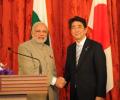
India and Japan are natural partners at sea, and Narendra Modi's recent visit underlined the need to keep the association going

India and the United States are working on efforts to improve cooperation on UN terrorist designations and expand the sharing of information on known or suspected terrorists "no matter where they may be located," says US Ambassador to India Richard Verma

Text of PM Narendra Modi's press statement after delegation level talks with US President Obama at the Hyderabad House in Delhi.

"We are committed to building a new India. We have to do this as early as possible," he said.
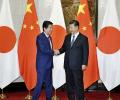
'Both Japan and China face a common challenge: How to deal with Trump.' 'The trade war with the US seems to have facilitated/hastened Abe's China visit, the first by a Japanese prime minister since 2011,' points out Dr Rajaram Panda.

'The focus on countering terrorism brings to the issue Beijing's non-serious approach in this regard. India's permanent representative at the UN has raised in vain the issue of funding and the release of 26/11 suspect Zaki-ur Rehman Lakhvi. But China has blocked these objections since December 2014 at the UN even after 'highest levels' in India intervened,' notes Srikanth Kondapalli, reviewing the India-China military exercises in Kunming.

Amid souring ties, the president visited Beijing for three days. On his return to India, a hope of better ties has arisen, says senior correspondent R Rajagopalan, who travelled with Pranab Mukherjee to the Asian superpower.
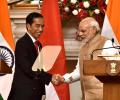
The two countries, among the very few fast growing large economies globally, also decided to boost bilateral trade and investment in areas of oil and gas, renewable energy, IT and pharmaceuticals, during talks between Prime Minister Narendra Modi and Indonesian President Joko Widodo.

Top security experts of India and the US met in New Delhi on Wednesday to discuss various measures, including exchange of technologies, to help each other face challenges like terrorism, cyber crime and ensuring safety of major cities.

The Indian government should resist the temptation to make a grand gesture of friendship towards Nawaz Sharif, says Shyam Saran
Coming down heavily on Pakistan, President Pranab Mukherjee has said unless it dismantles the terror infrastructure on its soil, there is no scope for progress in talks between the two countries.

Prime Minister Narendra Modi's visit to South Korea is considered essential in strengthening defence ties, enhancing economic cooperation and forging cultural ties between the two countries, says Dr Rahul Mishra

India and China on Wednesday signed in all nine agreements, including the Border Defence Cooperation Agreement and one on strengthening cooperation on trans-border rivers, after restricted and delegation-level talks that lasted over two hours as Prime Minister Manmohan Singh and Premier Li Keqiang met for the second time this year for talks which the Indian leader described as "fruitful and productive".
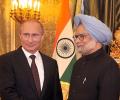
The 13-page joint statement issued after Prime Minister Manmohan Singh's annual summit with Russian President Vladimir Putin shows the breadth and depth of relations between the two countries and the trust factor that has been constant element behind it.

The prime minister, accompanied by senior officials including National Security Advisor Ajit Doval and Foreign Secretary S Jaishankar, met the Chinese leader just before his travel to Myanmar from this port city.

'We should expect a cold-blooded, transactional relation that requires a lot of engagement and mutual trust to sustain,' says Constantino Xavier, Fellow, foreign policy, Brookings India.

The two countries also asked all nations to stop cross-border movement of terrorists and asserted that a decisive collective response from the international community without 'double standards and selectivity' was required to combat the threat of terrorism.

The Saudi-Pakistan nuclear weapons cooperation is meant to sound alarm bells in Washington, reminding the Obama administration that its overtures to Iran would have serious negative consequences in terms of its ties with its closest allies in the region, says Ambassador Talmiz Ahmad. Exclusive to Rediff.com

Amid escalation in violence in a number of Gulf countries, India on Thursday expressed deep concern over the rise of fanaticism, extremism and terrorism in parts of the Arab region, saying they are tearing apart the fabric of societies as well as affecting regional stability.

India and China decided to seek a fair and rational solution to their border dispute on Saturday as they focused on the proposed border defence cooperation agreement to avert incursions like the one witnessed in Leh region last month.

Making it easier to do business is a key element of our strategy, says Foreign Secretary S Jaishankar.
 © 2026 Rediff.com - Advertise with us - Disclaimer - Privacy Policy - Sitemap - Feedback - About us - Terms of use - Grievances